
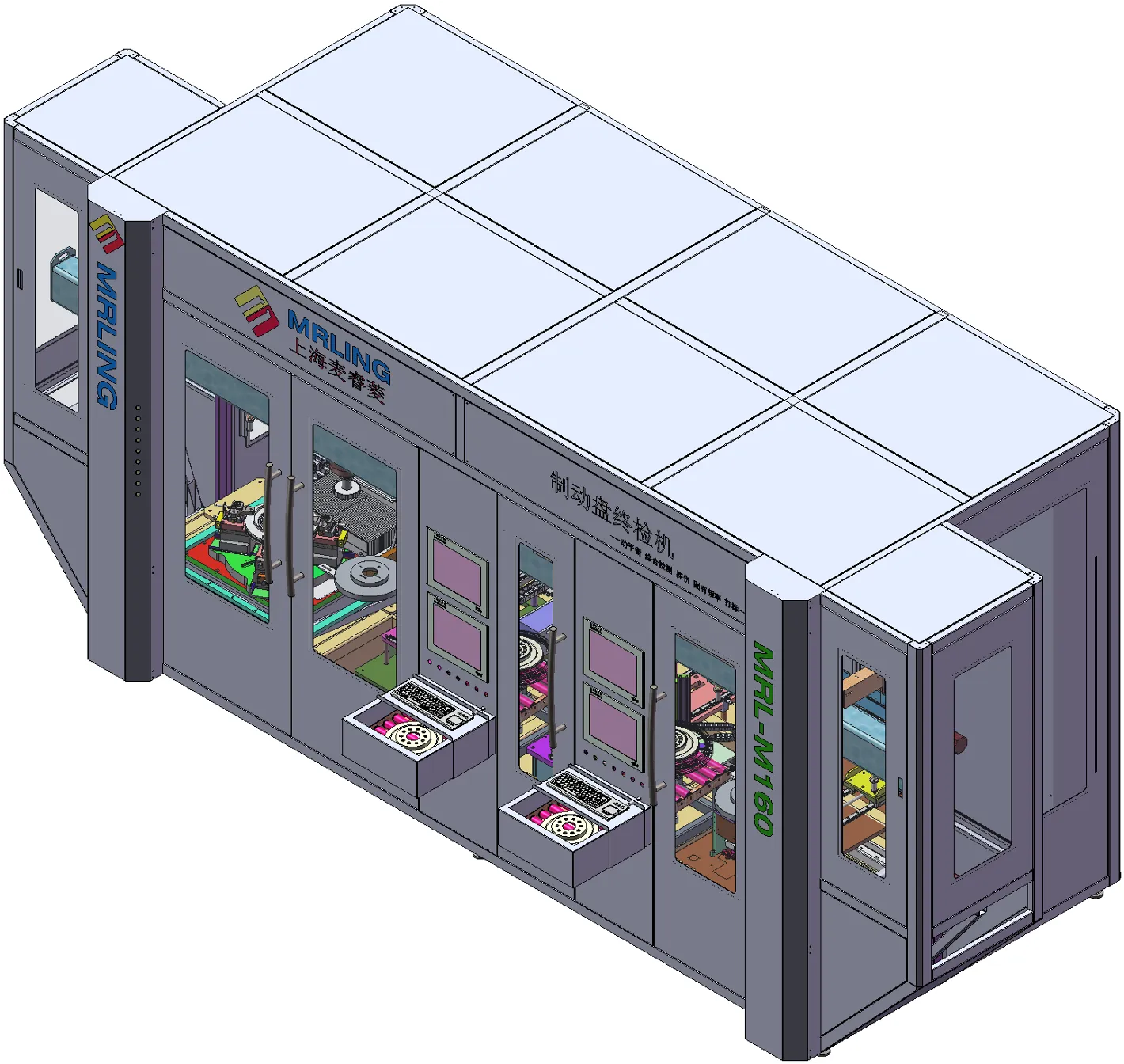
Brake Disc Fully Automatic Inspection Line
MRLing's flagship 6-station inline inspection line for brake discs — integrating dimensional measurement, eddy current crack detection, dynamic balancing and natural-frequency testing into one fully automated line.
The M160 integrates six process stations into one compact, fully automated line. Brake discs move through precision dimensional measurement, eddy current crack inspection, dynamic balancing, natural-frequency testing and laser marking without manual handling — delivering complete, traceable quality verification at production speed.
Built for high-volume brake disc manufacturing, the M160 runs a 30-second cycle time, helping manufacturers move from sampling inspection to inline inspection of every disc.
Full geometric inspection of critical disc dimensions with LVDT displacement sensors.
Automatic detection of surface cracks and material defects on every disc.
Balance test, automatic material removal and re-check completed in a single station.
FFT-based structural integrity check on every disc before shipment.
Permanent traceability marking and QR code for full part history.
Roller conveyor loading and unloading — no operator intervention required.
Six stations, one line. Every brake disc is checked for dimensions, cracks, balance and structural integrity — without manual handling.
LVDT displacement sensors measure critical disc dimensions. Every disc is checked, not just samples.
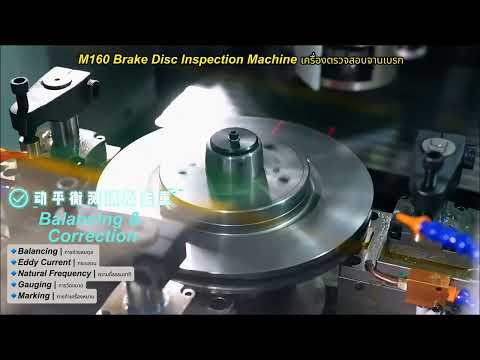
Piezoelectric sensors detect imbalance. The machine automatically removes material and re-checks — all in one station.
Eddy current sensors inspect every disc for surface cracks and material defects. No destructive testing needed.
| Parameter | Value |
|---|---|
| Inspection stations | 6 |
| Cycle time | 30 seconds |
| Loading and unloading | Automatic roller conveyors |
| Dimensional sensing | LVDT displacement sensors |
| Disc diameter range | 255–450 mm |
| Dimensional sensors | LVDT displacement |
| Balancing sensors | Piezoelectric |
| Crack detection | Eddy current |
| Natural frequency test | Accelerometer or microphone |
| Marking | Pneumatic pin or laser (optional laser QR code) |
| Material handling | Automatic roller conveyors (front and rear) |
Specifications are for reference. Actual configuration depends on your disc range and inspection requirements.
 ▶
Need a line configured for your brake discs?
Request a Quote